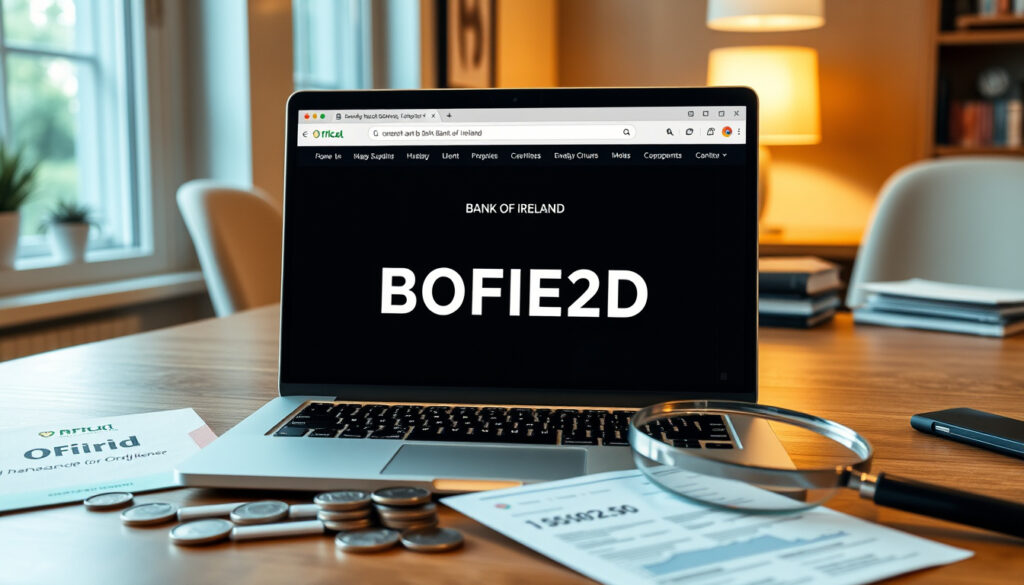
Bank of Ireland BIC Code: BOFIIE2D – How to Find It
If you’ve ever stared at an international transfer form wondering where on earth to find your Bank of Ireland BIC code, you’re not alone. These eight-character identifiers feel deliberately obscure until you actually need one. This guide cuts through that. The official Bank of Ireland BIC for Republic of Ireland accounts is BOFIIE2D, and here’s exactly how to get it.
Bank of Ireland BIC: BOFIIE2D ·
Full SWIFT Code: BOFIIE2DXXX ·
Primary Location: Republic of Ireland accounts ·
Usage: International payments ·
Alternative Name: SWIFT code
Quick snapshot
- BOFIIE2D is the official Bank of Ireland BIC for Republic of Ireland accounts (Bank of Ireland Official)
- Most Irish banks use 8-character BICs (Government of Ireland)
- Branch-specific BIC codes beyond the head office identifier are not publicly documented
- Historical timeline of when BOFIIE2D was first adopted remains unpublished
- Bank of Ireland updated 365online to convert existing payees with correct BIC/IBAN details for domestic payments (Bank of Ireland Personal Banking)
- BOFIIE2D verified and active in banking databases as of 2026 (Bank of Ireland Personal Banking)
- Bank of Ireland customers sending international payments will need BOFIIE2D alongside their IBAN (Bank of Ireland Official)
- Northern Ireland and GB customers use a different code: BOFIGB2B (Bank of Ireland Official)
The following table pulls together the core identifiers you need for Bank of Ireland international payments.
| Label | Value |
|---|---|
| Standard BIC | BOFIIE2D |
| Full BIC/SWIFT | BOFIIE2DXXX |
| Bank Name | BANK OF IRELAND |
| Country Code | IE |
| Official Source | bankofireland.com |
How do I find my BIC code at Bank of Ireland?
Bank of Ireland offers several official channels to locate your BIC code, with digital banking being the fastest option. Republic of Ireland customers have access to the most straightforward methods, while Northern Ireland and Great Britain customers face slightly different procedures.
Via online banking
If you hold a Republic of Ireland account, log into 365 Online and look for the expand symbol on the homepage—it reveals your BIC and IBAN directly. Northern Ireland and GB customers won’t find this shortcut on the homepage; instead, you need to access your eStatements through 365 Online to locate the information.
On bank statements
- Republic of Ireland customers: check the top right-hand corner of your account statement, where BIC and IBAN appear together
- All customers: eStatements display the BIC and IBAN in the statement header section
- Paper statements: look for the IBAN calculator section or international payments details block
Contacting support
Bank of Ireland’s Help Centre confirms that any Republic of Ireland account holds a BIC of BOFIIE2D. For Northern Ireland or Great Britain accounts, the BIC differs—BOFIGB2B. If you’re unsure which code applies to your account, Bank of Ireland support can confirm based on your account type and region.
Using the wrong BIC for your region can delay international payments or cause them to fail. Republic of Ireland and Northern Ireland customers have different codes—confirm your account’s region before sending money abroad.
The implication: knowing your account’s region before initiating a transfer prevents unnecessary delays or failures.
What is the BIC for Bank of Ireland?
The primary BIC code for Bank of Ireland depends on where your account is based. Republic of Ireland accounts use BOFIIE2D, while accounts in Northern Ireland and Great Britain use BOFIGB2B. Bank of Ireland also maintains a separate code for its United States operations: BOFIUS33XXX.
BOFIIE2D vs BOFIIE2DXXX
You might see both formats used interchangeably. The 8-character version BOFIIE2D is the standard identifier, while BOFIIE2DXXX includes the branch code suffix “XXX” to indicate the head office or primary branch. The Bank.codes directory confirms BOFIIE2D is registered as an active SWIFT code and can be written with or without the XXX suffix.
Most international payment systems accept both formats, but using the full 11-character version provides maximum compatibility across all banking networks and correspondent banks.
Bank of Ireland’s head office sits at 40 Mespil Road, Dublin, D04 C2N4, and the “2D” in BOFIIE2D specifically designates this head office location. The “XXX” suffix, when appended, makes explicit that you’re referencing the primary branch rather than a specific sub-branch.
What does BOFIIE2D mean?
The BIC code BOFIIE2D follows the SWIFT/BIC standard format, where each segment carries specific meaning. Understanding the breakdown helps you verify you’re using the correct code and explains why Bank of Ireland uses this particular sequence.
BIC structure breakdown
This table shows how each segment of the BIC code maps to a specific identifier within the SWIFT system.
| Characters | Component | Value | Meaning |
|---|---|---|---|
| 1–4 | Bank code | BOFI | Identifies Bank of Ireland |
| 5–6 | Country code | IE | Indicates Ireland |
| 7–8 | Location code | 2D | Head office designation |
| 9–11 | Branch code | XXX | Primary branch (optional) |
The Government of Ireland’s official guidance confirms that BIC codes can be either 8 or 11 characters long. Most Irish banks, including Bank of Ireland, use 8-character codes as the standard format. The first four characters always identify the bank, followed by the two-character country code, then the two-character location identifier.
The location code “2D” specifically indicates Bank of Ireland’s head office in Dublin. According to Wise’s SWIFT code reference, this “2D” code is what distinguishes the head office from any other potential Bank of Ireland branches that might carry different location codes. When combined with the XXX suffix, the code explicitly signals you’re referring to the main office rather than a specific sub-branch.
What is a Bank Identification Code (BIC code)?
A BIC code—Bank Identifier Code—is a unique address used in financial transactions to identify the specific bank or business involved. The Government of Ireland describes it as a unique address that, in payment messages, identifies precisely the bank or business, not the individual branch, involved in a transaction.
BIC vs SWIFT
BIC and SWIFT code refer to the same thing. BIC stands for Business Identifier Code, while SWIFT refers to the Society for Worldwide Interbank Financial Telecommunication organization that manages these codes. Bank of Ireland’s own guide states that BICs are often called SWIFT Codes and can be either 8 or 11 characters long.
The distinction is purely terminological: SWIFT developed and maintains the code system, so “SWIFT code” and “BIC code” describe identical identifiers. Bank of Ireland’s documentation uses both terms interchangeably, which reflects industry practice.
Is your BIC part of your IBAN?
No—your BIC code and your IBAN are separate identifiers that work together. The IBAN (International Bank Account Number) identifies your specific account, while the BIC identifies your bank. Both are required for international payments to Ireland, but they serve distinct purposes.
BIC and IBAN relationship
Bank of Ireland explains that the combination of your BIC and IBAN enables you to make and receive payments internationally or within Ireland. Your IBAN starts with “IE” for Irish accounts and is 22 characters long. It encodes your country, check digits, bank identifier, and your specific account number.
An example Irish IBAN format is IE64IRCE92050112345678. Notice how it begins with the country code “IE” but doesn’t contain your bank’s BIC. The BIC must be provided separately when initiating international transfers. Ireland’s standard IBAN length of 22 characters applies to all domestic accounts, and the Government of Ireland confirms this as the national standard.
When you send an international payment to an Irish account, you’ll typically need to provide three pieces of information: the recipient’s IBAN, the bank’s BIC (BOFIIE2D for Bank of Ireland Republic of Ireland accounts), and optionally the recipient’s name and address. Some payment providers may also request the bank’s full address—Bank of Ireland’s head office is at 40 Mespil Road, Dublin, D04 C2N4.
How to find your Bank of Ireland BIC code
Here’s the step-by-step process to locate your specific BIC code through Bank of Ireland’s official channels.
Digital channels give you instant access, but the specific code you need depends on your account’s region. Republic of Ireland customers see their BIC on the 365 Online homepage; Northern Ireland and GB customers must dig into eStatements. Know your account’s region first.
- Identify your account region: Republic of Ireland accounts use BOFIIE2D. Northern Ireland and Great Britain accounts use BOFIGB2B. If you’re unsure, check the country designation in your online banking profile.
- For Republic of Ireland customers via 365 Online: Log in to Bank of Ireland’s BIC and IBAN support page, click “Access 365 Online” and log in, then expand the symbol on the homepage to reveal your BIC and IBAN together.
- For Republic of Ireland customers via mobile app: Open the Bank of Ireland App, tap “Accounts,” select your account, and tap “BIC/IBAN” at the top of the screen. This displays both codes instantly for Republic of Ireland accounts.
- For Northern Ireland and GB customers: Access 365 Online and navigate to eStatements. Your BIC (BOFIGB2B) and IBAN appear in the statement header. Note that the homepage shortcut is not available for these accounts.
- Via bank statements: Check either paper statements or eStatements. For Republic of Ireland accounts, look at the top right-hand corner of your statement. Both BIC and IBAN appear there. eStatements for all account types display the codes in the header section.
- Using the IBAN Calculator: Visit Bank of Ireland’s IBAN Calculator tool, enter your sort code and account number, and the tool generates your IBAN. Your BIC remains BOFIIE2D (Republic of Ireland) or BOFIGB2B (Northern Ireland/GB) based on your account type.
- By contacting support: If you’ve tried the above methods and still can’t locate your code, call Bank of Ireland’s customer support or use the in-app chat function. Support staff can confirm your BIC based on your account details.
A BIC is a Bank Identifier Code. It is unique to your Bank.
— Bank of Ireland (Personal Banking support)
The BIC (Business Identifier Code) is a unique address which in payment messages identifies precisely the Bank/Business (not the Branch) involved in a financial transaction.
— Government of Ireland, Department of Social Protection (Official guidance)
BICs are often called SWIFT Codes and can be either 8 or 11 characters long. Bank of Ireland’s BIC is BOFIIE2D.
— Bank of Ireland (IBAN, SWIFT and BIC explained)
Related reading: IRES REIT share price · Coca-Cola share price
qonto.com, personalbanking.bankofireland.com, bankofireland.com, skydo.com, remitly.com
Frequently asked questions
How do I find my BIC boi?
For Republic of Ireland accounts, log into 365 Online and expand the symbol on the homepage to see your BIC (BOFIIE2D). For Northern Ireland and GB accounts, access 365 Online eStatements where your BIC (BOFIGB2B) appears in the statement header. You can also check the Bank of Ireland App for Republic of Ireland accounts or review your paper or digital bank statements.
What is the BIC for boi?
Bank of Ireland’s BIC is BOFIIE2D for Republic of Ireland accounts and BOFIGB2B for Northern Ireland and Great Britain accounts. These codes are confirmed by Bank of Ireland’s official Help Centre. Always verify you’re using the correct code for your account’s region before initiating international payments.
Can I find my BIC online?
Yes. Republic of Ireland customers can find their BIC on the 365 Online homepage by expanding the symbol. Northern Ireland and GB customers find it in eStatements. The Bank of Ireland Help Centre confirms both methods are official and reliable.
How do I find a bank BIC number?
Check your bank’s official website, online banking portal, or bank statements first. You can also use SWIFT’s BIC directory directly or consult third-party databases like Bank.codes or XE.com. For Bank of Ireland specifically, the official codes are listed on their Help Centre pages.
What is BOFIIE2DXXX?
BOFIIE2DXXX is the full 11-character version of Bank of Ireland’s BIC code. The standard 8-character version is BOFIIE2D, and appending “XXX” makes explicit that you’re referring to the head office or primary branch. Both formats are valid and widely accepted for international payments, though the 8-character version works in most cases.
More related posts
 Who Is The Richest Person In The World – Forbes Real-Time Rankings
 สล็อต m.pglucky88.win ✅ Review: Is It Safe and Legitimate
 Early Signs of MS in Women: Complete Guide to Symptoms
 Oldest Person in Ireland 2026: Record & Update
 How to Get Rid of Diarrhoea: Fast Relief and Treatment
 Cinema Dublin City Centre: Showtimes, Deals & Top Picks
 Signs of Colon Cancer: 7 Early Warning Symptoms and Red Flags
 Our Lady of Clonfert: Story, Location & Mass Times